
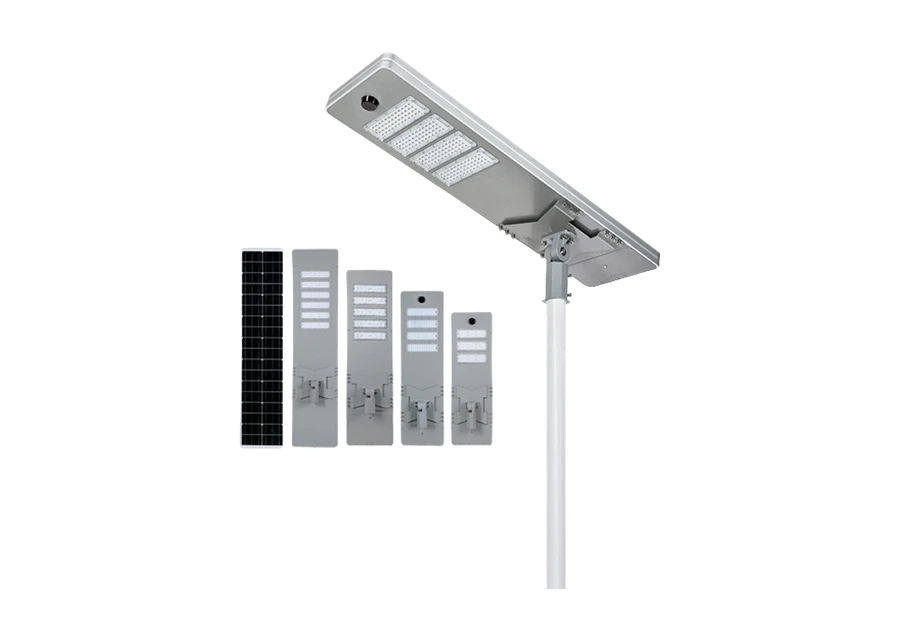
Short answer: choose a solar street light by matching brightness (lumens) to the road or area, checking the LED efficacy (lm/W) and LiFePO4 battery sized for several cloudy nights, and using smart controls (PIR motion + dusk-to-dawn + dimming) to stretch autonomy. Weatherproofing (IP66) and pole height complete the specification.
Step 1 — Match brightness to the job
Bigger roads and open areas need more lumens; paths and yards need less. As a rough guide:
| Area | Typical output |
|---|---|
| Paths, gardens, entrances | Lower (hundreds to low thousands of lm) |
| Compounds, car parks, side roads | Medium |
| Main roads, large yards | High (up to ~21,600 lm) |
Step 2 — Check LED efficacy
Higher lm/W (up to ~180 lm/W on quality fixtures) means more light per watt, so the same battery runs longer. A 50,000-hour rated LED life keeps maintenance low.
Step 3 — Size the battery for cloudy nights
Autonomy depends on the LiFePO4 battery (rated for 2000+ cycles, not consumer Li-ion) and the panel. Size for several nights without full sun in your climate — smart dimming extends this.
Step 4 — Use smart controls
- PIR motion — full brightness on movement, dimmed otherwise, to save energy.
- Dusk-to-dawn — automatic on/off.
- Dimming schedules — stretch autonomy through rainy spells.
Step 5 — Weather and mounting
Choose IP66 die-cast aluminium housings for the outdoors, and the right pole height (commonly 4–10 m) for the area.
Checklist
- Lumens matched to the area
- High lm/W LED, 50,000-hour life
- LiFePO4 battery sized for cloudy nights
- PIR + dusk-to-dawn + dimming
- IP66 housing, correct pole height
COTECH Solar offers all-in-one street, wall, garden lights and home kits — up to 21,600 lm, 180 lm/W, LiFePO4, PIR smart control, IP66. See Solar Lighting or ask our team.
FAQ
How many lumens do I need for a solar street light?
It depends on the area: paths and gardens need only hundreds to a few thousand lumens, side roads and compounds need more, and main roads or large yards can need up to around 21,600 lumens. Match the output to the size and use of the space you're lighting.
How long do solar street lights stay on at night?
A well-sized solar street light runs dusk-to-dawn on a full charge, with autonomy for several cloudy nights depending on the LiFePO4 battery and panel size. Smart dimming and PIR motion control extend runtime through extended bad weather.
Why is LiFePO4 better for solar street lights?
LiFePO4 batteries are rated for 2000+ cycles and handle heat and cold better than consumer lithium-ion, so a solar street light lasts far longer before the battery needs replacing — important for lights left outdoors for years.