
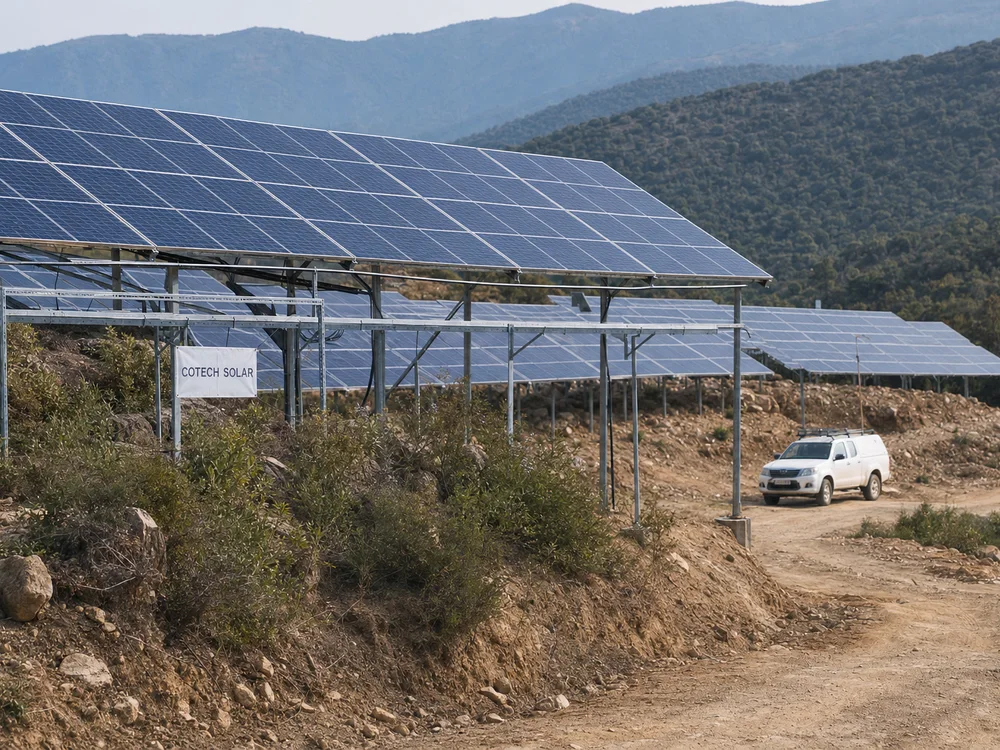
Over the past few years the solar industry has shifted decisively from p-type PERC cells to N-type TOPCon, which is now the mainstream module technology offered by most tier-one manufacturers. For buyers evaluating new projects, understanding why helps in comparing quotes on equal terms.
What makes N-type TOPCon different
TOPCon (Tunnel Oxide Passivated Contact) builds on an n-type silicon wafer with a passivating contact layer that reduces electrical losses. Compared with the older p-type PERC structure, it typically delivers:
- Higher conversion efficiency — commercial modules now reach the low-to-mid 22–23% range.
- Lower degradation — n-type silicon is largely free of the light-induced degradation (LID) tied to boron-oxygen defects in p-type cells.
- A lower temperature coefficient, so modules lose less power on hot days.
- Higher bifaciality, capturing more reflected light on the rear side in ground-mount and elevated installs.
What it means for project economics
Higher efficiency means more watts per square metre, so a given roof or plot produces more energy — reducing balance-of-system cost per watt. Lower degradation and better temperature behaviour raise the energy yield over the system's life, which is what ultimately drives the levelised cost of electricity (LCOE).
What to check when comparing modules
- Confirm the module is genuinely N-type (TOPCon, HJT or back-contact), not rebadged PERC.
- Compare the power warranty — leading dual-glass modules now offer a 30-year linear guarantee.
- Look at the first-year and annual degradation figures, not just the nameplate power.
COTECH Solar's on-grid range is built entirely on N-type platforms — TOPCon, HJT and back-contact — up to 730 W. Browse the Solar Modules page or talk to our engineers to compare specifications for your project.