
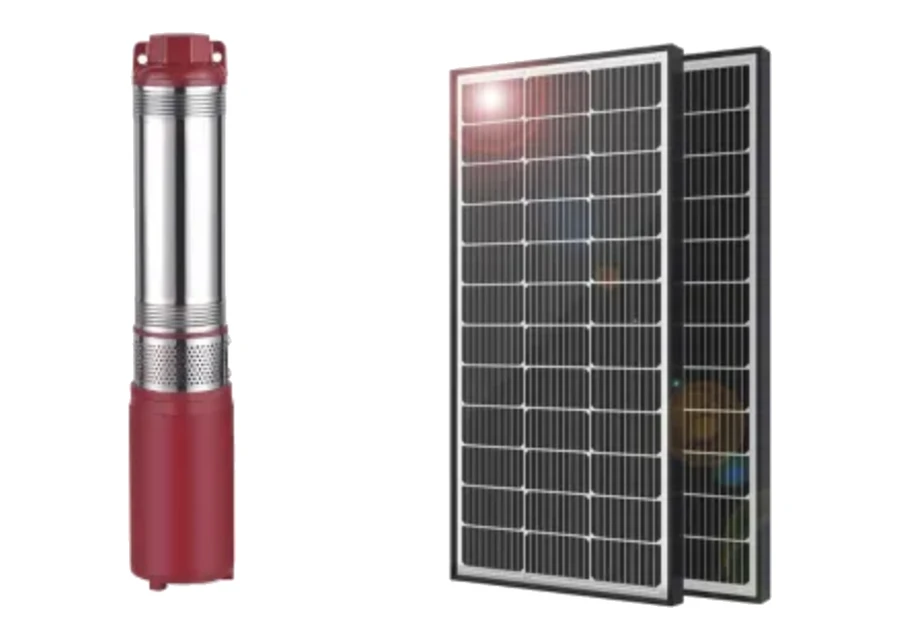
Short answer: size a solar pump from two numbers — the total head (the total height and friction the water must be pushed against, in metres) and the required flow (how much water per day or hour, in m³). Together they set the pump model; the solar array is then sized so the pump reaches full output during peak sun.
Step 1 — Work out the total head
Total head is not just well depth. Add up:
- Vertical lift — from the water level (when pumping) up to the outlet or tank.
- Drawdown — how much the water level drops while pumping.
- Friction loss — pressure lost in the pipe over its length (longer or narrower pipe = more loss).
- Pressure requirement — any extra pressure needed at the outlet (e.g. for sprinklers).
The sum, in metres, is your total dynamic head (TDH).
Step 2 — Work out the required flow
- For irrigation, estimate daily water need (crop area × water per m²) and the hours of good sun to pump it.
- For livestock or supply, use daily demand and peak draw.
- Convert to a target m³/h the pump must deliver at your head.
Step 3 — Match head and flow to a pump
Pump performance is a curve: flow falls as head rises. Pick a pump whose curve delivers your required flow at your total head.
| Application | Typical head | Typical flow |
|---|---|---|
| Deep borehole / village supply | High (up to ~150 m) | Lower m³/h |
| Irrigation mains / high flow | Low–medium | High (tens of m³/h) |
| Pool / pond circulation | Low | Medium |
Step 4 — Size the solar array
Size the panels so the pump reaches full power around solar noon. A pump with built-in MPPT extracts more from the panels across the day and starts earlier and stops later. AC/DC hybrid pumps can also run on grid or generator at night.
Common mistakes
- Using well depth as the head and ignoring drawdown, friction and pressure.
- Undersizing the array so the pump never reaches rated flow.
- Ignoring dry-run protection for wells that can run low.
COTECH Solar offers deep-well submersibles (to 150 m), AC/DC hybrids (to 56 m³/h), pool and economy pumps — all with MPPT and dry-run protection. See Solar Water Pumps or send your head and flow for a sizing.
FAQ
How do I calculate the head for a solar pump?
Total head (total dynamic head) is the vertical lift from the pumping water level to the outlet, plus the drawdown as the water level falls while pumping, plus friction loss in the pipe, plus any pressure needed at the outlet. Add these in metres to get the head the pump must overcome.
What size solar water pump do I need for irrigation?
Work out your daily water requirement (crop area times water per square metre) and the hours of good sun available to pump it, to get a target flow in m³/h. Then choose a pump whose performance curve delivers that flow at your total head, and size the panel array to reach full power at midday.
Do solar pumps work when there's no sun?
Standard solar pumps run while the sun is shining. AC/DC hybrid models can also switch to grid power or a generator to run at night or in cloudy weather, and pumping into a storage tank during the day is a common way to cover night-time demand.