
Short answer: N-type modules generally outperform older p-type PERC modules on efficiency, degradation and temperature behaviour, which means more energy over the system's life. As N-type has become mainstream, its price premium over PERC has narrowed, making it the default choice for most new projects.
The core difference
The label refers to how the silicon wafer is doped. P-type cells (the basis of PERC) use boron-doped silicon; N-type cells use phosphorus-doped silicon. That single change removes the boron-oxygen defect responsible for much of the light-induced degradation (LID) seen in p-type modules, and it enables higher-performance cell structures such as TOPCon, HJT and back-contact.
N-type vs p-type PERC at a glance
| Attribute | N-type (TOPCon / HJT / BC) | P-type (PERC) |
|---|---|---|
| Module efficiency | Higher (~22–23%) | Lower (~20–21%) |
| First-year degradation | Lower | Higher |
| Annual degradation | Lower | Higher |
| Temperature coefficient | Better (less loss in heat) | Worse |
| Bifaciality | Higher | Lower |
| Status | Industry mainstream | Being phased out |
Why it matters for project economics
- More watts per square metre — higher efficiency means a given roof or plot yields more power, lowering balance-of-system cost per watt.
- A stronger year-30 guarantee — lower degradation is why leading N-type dual-glass modules now carry a 30-year linear power warranty.
- More energy on hot days — a better temperature coefficient raises real-world yield in warm climates, where PERC loses more.
What to check when comparing quotes
- Confirm the module is genuinely N-type, not rebadged PERC.
- Compare the degradation curve (first-year and annual), not only the nameplate watts.
- Compare the power warranty term — 30-year linear is now standard on premium dual-glass N-type modules.
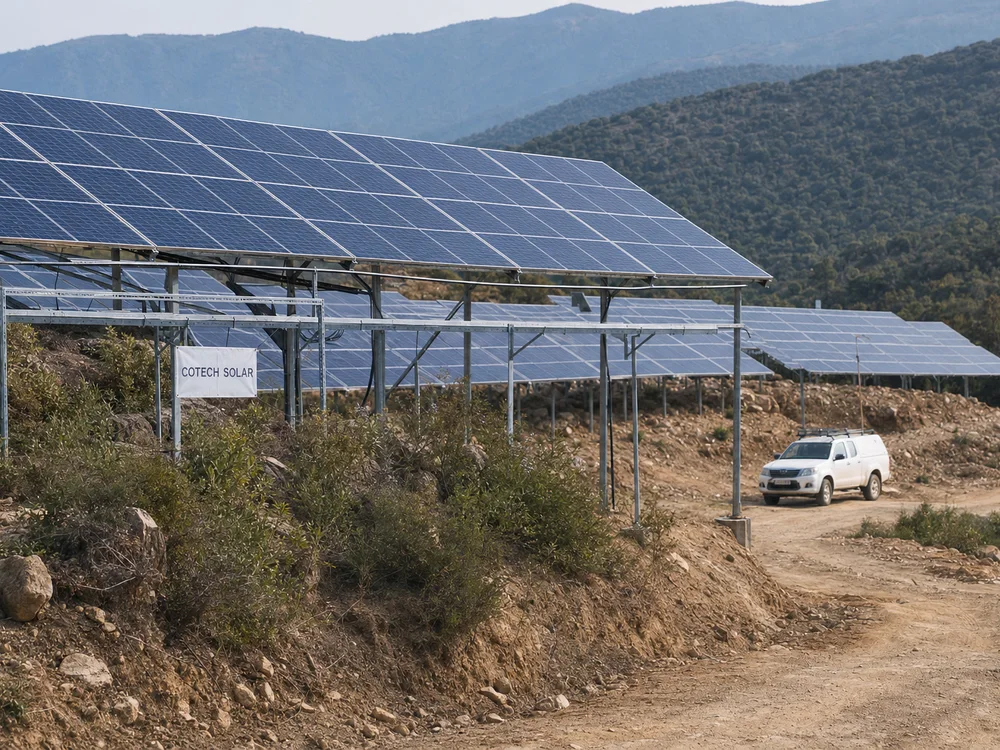
COTECH Solar's on-grid range is built entirely on N-type technology. See the Solar Modules page or request a quote to compare specifications.
FAQ
Is N-type really better than PERC?
For most projects, yes. N-type modules typically offer higher efficiency, lower degradation and a better temperature coefficient than p-type PERC, so they generate more energy over their lifetime. PERC is now being phased out as N-type has become the industry mainstream.
Does N-type cost much more than PERC?
There is usually a small premium, but it has narrowed significantly as N-type production has scaled up and become mainstream. Because N-type produces more energy per installed watt, the higher yield often offsets the price difference over the system's life.
What are TOPCon, HJT and back-contact?
They are the three main N-type cell technologies. TOPCon is the mainstream, cost-effective option; HJT offers the lowest temperature coefficient and highest bifaciality; back-contact gives an all-black appearance for premium rooftops. See our TOPCon vs HJT vs back-contact guide for a full comparison.