
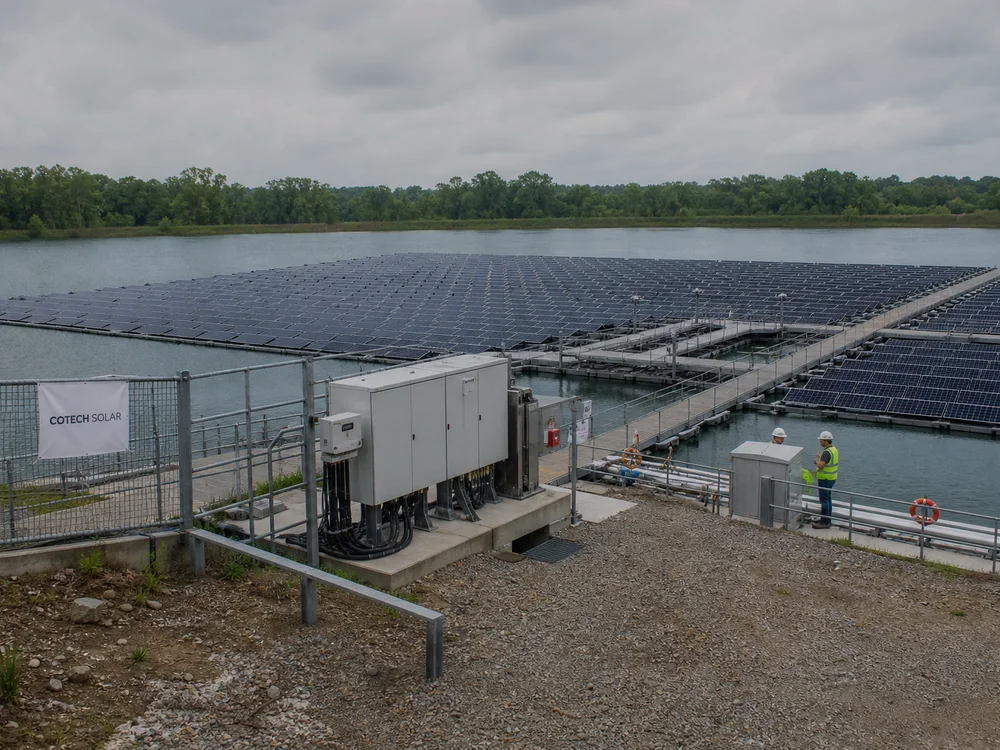
Short answer: floating solar (FPV) mounts modules on buoyant platforms over calm water — reservoirs, ponds, irrigation basins and treatment plants. It makes sense where land is scarce or expensive but water surface is available, and it brings two bonuses: it saves land and the water can help cool the modules, while also reducing evaporation. It needs UV-stable materials and careful anchoring, so it suits sheltered water rather than open, wavy lakes.
How floating solar works
- Modules sit on UV-stabilised HDPE floats that lock together into a platform.
- The platform is anchored to the bed or banks to hold position against wind and water-level changes.
- Cabling runs to shore, where it connects like any ground array.
Benefits
- Saves land — uses otherwise unused water surface, freeing land for other uses.
- Reduces evaporation — shading the water cuts losses, valuable for reservoirs and irrigation.
- Potential cooling — proximity to water can moderate module temperature.
- Fits existing sites — hydro reservoirs, water utilities and industrial ponds already have grid links.
Challenges to plan for
- Anchoring and water-level swings — the mooring must handle changing levels and wind.
- Materials — floats and fixings must resist UV and, in some waters, corrosion or biofouling.
- Access and O&M — maintenance is by walkway or boat, so design for safe access.
- Suitable water — best on calm, sheltered water; open lakes with waves are harder.
Where FPV is the right choice
- Water utilities and hydro reservoirs with spare surface and a grid connection.
- Regions where land is scarce or costly but calm water is available.
- Sites that also benefit from reduced evaporation.
COTECH Solar supplies UV-stabilised HDPE floating PV platforms (5/10/15° tilt, walkway-rated) alongside its ground and roof systems. See Mounting System or ask about a floating project.
FAQ
What is floating solar?
Floating solar, or FPV, is a photovoltaic system mounted on buoyant platforms over water such as reservoirs, ponds and basins. The floats lock together and are anchored in place, with cabling running to shore. It saves land and can reduce water evaporation.
What are the benefits of floating solar?
FPV uses unused water surface instead of land, reduces evaporation by shading the water, and can benefit from the cooling effect of being near water. It suits sites with spare calm water and an existing grid connection, such as reservoirs and water utilities.
Is floating solar suitable for any body of water?
No. FPV works best on calm, sheltered water such as reservoirs, ponds and treatment basins. Open lakes with significant waves and large water-level swings are more challenging, requiring more robust anchoring and materials, and may not be suitable.