
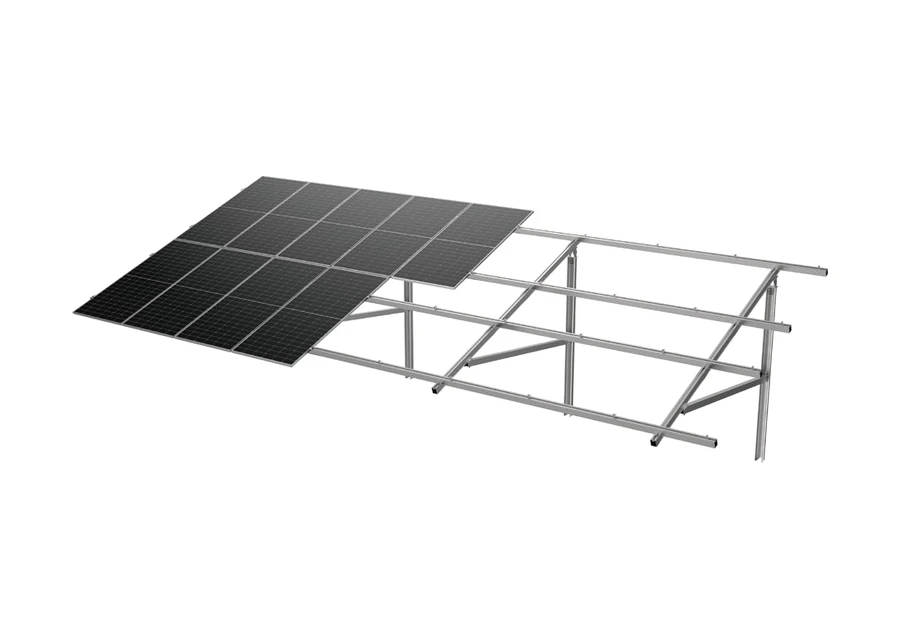
Short answer: the mounting system follows the site. Roof systems (tile, metal, flat) suit buildings; ground mounts suit open land; carports turn parking into generation; single-axis trackers raise yield on large open sites; and floating structures use reservoirs and ponds where land is scarce. Whatever the type, the structure must be engineered for local wind and snow loads and built from corrosion-resistant materials.
The main mounting types
| Type | Where it fits | Notes |
|---|---|---|
| Pitched roof (tile / metal) | Homes, commercial buildings | Hooks or clamps, leak-free fixings |
| Flat roof | Commercial / industrial roofs | Ballasted or anchored, set tilt |
| Ground-mount | Open land, utility, C&I | Screws, concrete or driven piles |
| Carport | Car parks, EV charging | Adds shade + generation |
| Single-axis tracker | Large open ground sites | Follows the sun for higher yield |
| Floating (FPV) | Reservoirs, ponds, basins | Saves land, cools modules |
What decides a durable structure
- Engineered loads — wind (commonly rated to 50–60 m/s) and snow (e.g. up to ~1.6 kN/m²), with a project structural calculation to the relevant code (AS/NZS 1170.2, ASCE 7, EN 1991).
- Materials — anodised aluminium (AL6005-T5), stainless steel and hot-dip galvanised or ZAM-coated steel; a C5-M coastal option for salt-heavy sites.
- Speed of installation — pre-assembled kits and repeatable pile grids cut site labour.
- Roof integrity — for roofs, leak-free hooks and correct clamps for the roof type.
How to shortlist
1. Identify the surface: roof (which kind), ground, water or car park. 2. Get the local wind and snow load requirement. 3. Choose the material grade for the environment (standard vs coastal). 4. Decide fixed-tilt or tracker for ground sites (see our trackers guide).
COTECH Solar supplies roof, ground, carport, balcony, single-axis tracker and HDPE floating systems, wind-rated to 60 m/s. See Mounting System or send your site details for a structural recommendation.
FAQ
What type of solar mounting do I need?
It depends on the surface. Use roof systems (tile, metal or flat) on buildings, ground mounts on open land, carports over parking, trackers on large open sites for higher yield, and floating structures on water where land is scarce. In every case the structure must be engineered for local wind and snow loads.
What wind and snow loads should a solar mount handle?
It varies by location and code, but quality systems are commonly rated to around 50–60 m/s wind and snow loads up to roughly 1.6 kN/m². A project-specific structural calculation to the applicable standard (such as AS/NZS 1170.2, ASCE 7 or EN 1991) should confirm the design for your site.
What material is best for solar mounting in coastal areas?
Coastal sites need extra corrosion protection. Look for anodised aluminium, stainless steel, or ZAM/hot-dip galvanised steel, ideally with a C5-M coastal-grade rating and a long salt-spray test result, to resist salt-laden air.