
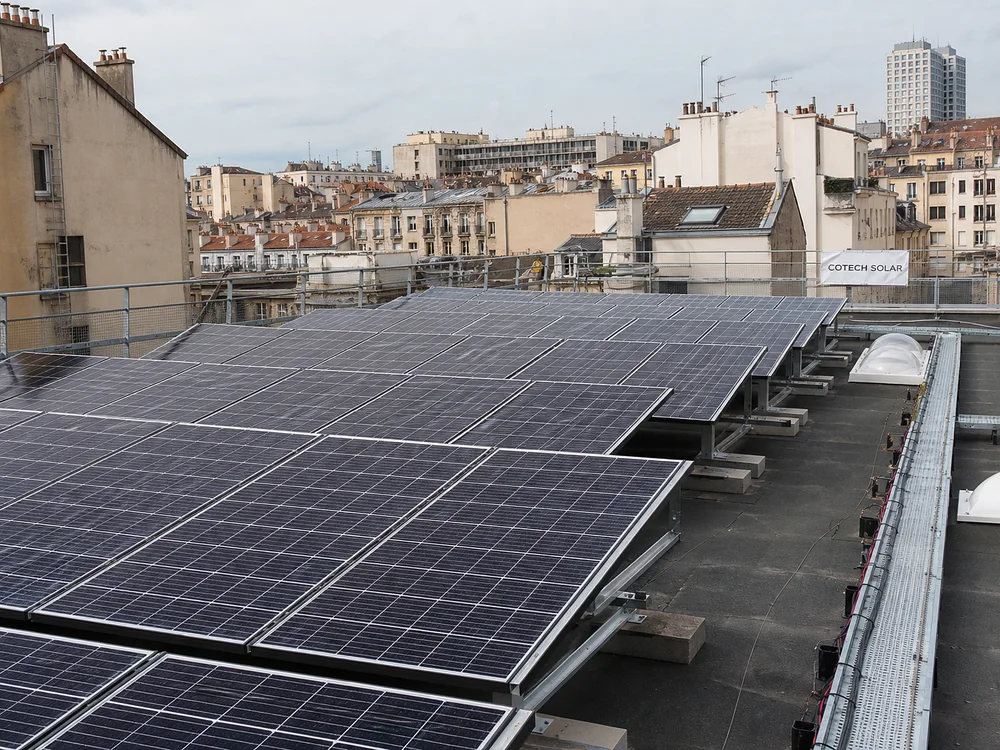
Short answer: match the module to the job. Residential rooftops favour higher-power, good-looking modules (all-black back-contact or TOPCon); commercial and utility projects favour high-power bifacial TOPCon or HJT for the lowest cost per watt; off-grid systems use smaller 12/24 V, flexible or portable panels sized to the load and battery.
Step 1 — Start from the application
| Project type | Priorities | Typical choice |
|---|---|---|
| Residential rooftop | Aesthetics, power in limited area | Back-contact (all-black) or TOPCon, 430–660 W |
| Commercial / industrial roof | Cost per watt, roof load | TOPCon bifacial, 550–725 W |
| Utility / ground / tracker | Yield, cost per watt, bifacial gain | TOPCon or HJT bifacial, up to 730 W |
| Off-grid (RV, boat, cabin) | Voltage match, size, weight | 12/24 V off-grid, flexible or portable |
Step 2 — Pick the power class and format
- Higher power per module (Wp) can mean a larger panel, not more watts per square metre. Compare module efficiency and the actual roof layout, including setbacks and obstructions, then check weight and access.
- Bifacial dual-glass adds rear-side yield on reflective surfaces (white roofs, ground, trackers) and is more durable; mono-facial is fine for dark flat roofs.
- Off-grid needs the module voltage matched to the battery/charge controller (12 V, 24 V or higher).
Step 3 — Compare the numbers that matter
- Efficiency — more watts per square metre in tight spaces.
- Temperature coefficient — important in hot climates.
- Degradation and warranty — look for a 30-year linear power warranty on premium N-type dual-glass modules.
- Certifications — IEC, UL, TÜV, CE for the target market.
Step 4 — Don't forget the balance of system
The module is one part of the project. Pair it with the right mounting system for the roof or ground type, and — where self-consumption or backup matters — energy storage.
COTECH Solar offers on-grid (TOPCon, HJT, back-contact up to 730 W), plus off-grid, flexible and portable modules. Browse the Solar Modules page or tell us about your project for a tailored recommendation.
Compare two documented large-format options
For a commercial roof or ground array, compare the format before choosing the highest wattage:
| Model-specific data | Dimensions | Weight | Main selection check |
|---|---|---|---|
| CSTB72 580–605W TOPCon | 2278 × 1134 × 30 mm | 31.5 kg | Roof geometry, lifting and approved clamp positions |
| CSHJ132 700–730W HJT | 2384 × 1303 × 33 mm | 37.0 kg | Larger rack footprint, handling and inverter current limits |
These are alternatives for suitable projects, not interchangeable replacements. Each model page links its source PDF and lists all STC power bins, electrical limits and document inconsistencies to resolve before ordering. For compact roofs, also compare the CSTB54 TOPCon series. Send the selected model, quantity, destination, roof layout and inverter model with your enquiry; confirm the drawing, certificates and signed warranty before procurement.
FAQ
What size solar module is best for a home?
For most homes, modules in the 430–660 W range work well, balancing power output with weight and handling on a residential roof. All-black back-contact or TOPCon modules are popular for their appearance. The exact choice depends on available roof area and your target system size.
Which solar module is best for hot climates?
In hot climates, look for a low temperature coefficient so the module loses less power as it heats up. HJT modules lead here, and N-type TOPCon also performs better than older PERC. Bifacial modules can add extra yield on reflective ground or rooftops.
What modules should I use for an off-grid system?
Off-grid systems use panels matched to the battery voltage (commonly 12 V or 24 V) and sized to the daily load. Flexible and portable panels suit vehicles, boats and cabins. See our off-grid modules for the available range.